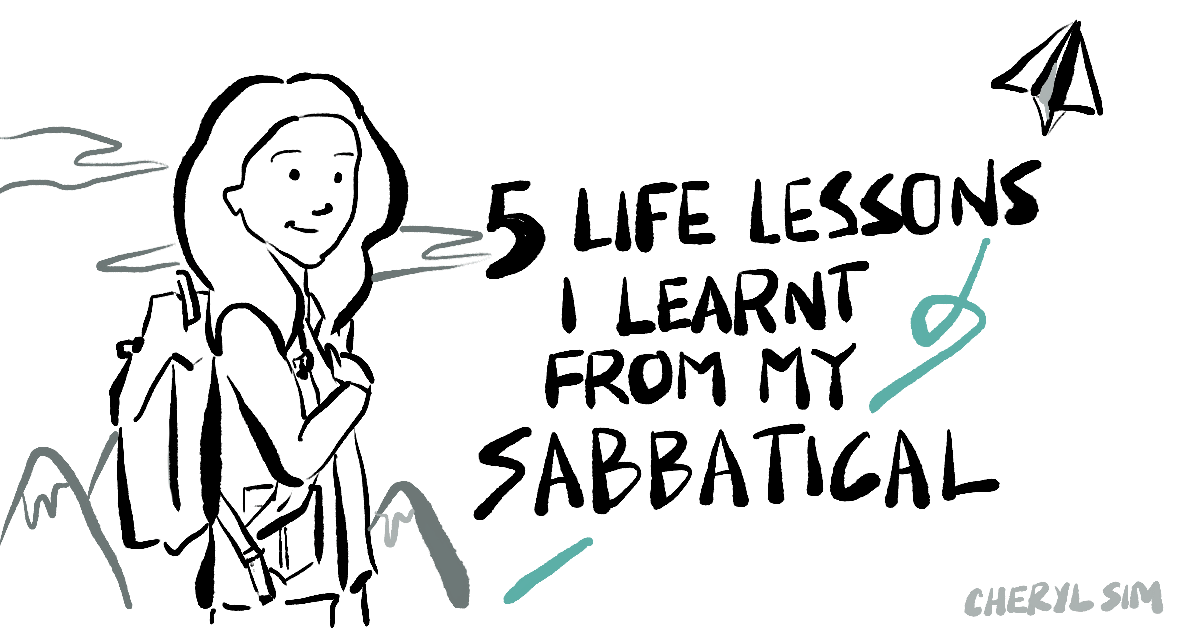
Last July, I took time off work. I was in the midst of a transition between two teams, and was fortunately given the opportunity to have a sabbatical before returning to my new role. I had spent all my time up to that point in my career seemingly hurtling non-stop through doors that opened up for me, and I was deeply thankful for the time off. Because if I were honest with myself, I felt something was amiss. I wanted space to self-reflect, spend time with myself and my family, and recalibrate my sails so I could ensure I was heading in the direction I wanted, instead of being led through life by some other-imposed GPS.
I never expected my sabbatical to be such a powerful experience. I was working round the clock to launch two major regional projects up till the final day of work, and did not have mind-space to make any plans entering the sabbatical. On the first morning of my sabbatical, I woke up and felt like there was a chasm in my life. I had the next 5.5 months looming ahead of me, for the first time with no work and no commitments (and no income). For someone who had lived her whole life filling every bit of free time with multiple projects with no downtime, I felt bewildered. It was as though I had been thrust blank pieces of paper, with a pen in my hand I was not used to holding, and told to do as I will. What do I do with myself?
Now, standing on the other end of that looming chasm, I’m proud of the words I wrote on those once-blank pages. Here are some important life lessons I learnt from my time off work (which I still hold on to and remind myself of):
Lesson 1. Fill yourself with things that light you up.
This was a great piece of advice given to me by a friend right before my sabbatical. She might have said it in passing, but it was something I clung onto throughout my sabbatical and even now. Now when faced with a choice, I ask myself, “Does this light me up? Do I feel energised by the task at hand?”
To start, I thought back to my childhood. I would lose myself in art and stories, creating imaginary worlds and characters. My heart still skips a beat when I see great designs and architecture. Yet, just like how we’ve locked the knights and heroes of our childhood imaginations away because they were no longer ‘useful’, I had also locked away this part of myself in adulthood because I had deemed Artist Cheryl as impractical. I had to fish my artist self out, dust her off, acknowledge that I had snuffed out her light, and give her space to work in my current life.
By the end of my sabbatical, I had started a daily practice of illustration, graphic recorded at a number of international conferences, led a workshop at TEDx Singapore, and launched an Instagram account for my art (@greatly.ink).
We are all made of energy. If you’re constantly in sub-optimal circumstances, you will feel it. They may be circumstances that you’re sub-consciously living with, or resigned to. These circumstances will drain you. Slowly or quickly, like a leech. It’s just a matter of time. Take stock of what in your life isn’t serving you and purge those. Find the moments in your life where you felt alive, and clear some space in the present for them again.
Lesson 2. The world is wide. We have a lot more choice than we think we do.
I ended up solo-travelling to 7 countries during my sabbatical. Back in college, I used to travel frequently and immerse myself in different societies for months on end as a Sociology and Public Policy major. In fact, I hadn’t returned home for 3 years because I felt the urgency to always be somewhere else in the world. Travel was again something I had neglected once I started working, and I had nearly forgotten its magic.
The magic of travel is that it teaches you that the world is wide, and you are small. Small not in a bad way. Small in a way that makes you realise that the multitude of possibilities available are expansive, if you choose to look.
There are so many ways of living, so many paths to success, so many ways to be content — if you will let yourself choose. Sometimes, staying in one society for a long time makes you think that there is one set trajectory to success. It’s no wonder there is sometimes a paralysing sense of having to live life in that one obligatory way. Travelling, speaking to others and reflecting goes a long way in helping shrug those blinders off. We have a lot more choice than we think we do — if we choose to see.
Lesson 3. Real wealth is in freedom. Real power is in discipline.
One of my favorite books I read during my sabbatical was Haemin Sunim’s “Love for Imperfect Things: How to Accept Yourself in a World Striving for Perfection”. In another of his books, he says:
“Your freedom is more important than money. It is better to live the kind of life you want than to earn more and be constrained. Don’t sell your freedom.”
Those 5.5 months of blank pages were freedom. I had the autonomy to choose how and where to allocate my time and energies. Yet freedom amounts in nothing without intention. I realised that the real power is in the discipline to harness that freedom.
Within a week of my sabbatical, I had a broad plan of what I wanted to accomplish with my time, categorised along the various spectrums of my life (more on this on a later post). I started studying the power of habits and routines, and sought help where I needed. This helped build structure and a regime in that free-form season, just like an outline for an essay.
I started tracking my habits using the Habits app, a practice I still continue till today. I deepened my relationships with mentors. I started shadowing leaders in fields I was interested in. I started a daily practice of illustration.
Lesson 4. Don’t scrimp on investing in yourself.
There were moments during my sabbatical where I had to seriously consider the financial costs of pursuing certain goals, since I was tapping on my savings.
Something a mentor once said to me was incredibly helpful when I was considering the expenses:
Money is to help fuel your life’s purposes. You save today so as to help your future self, when the time comes around. You just need the wisdom to recognise when that is.
I knew that such ‘time wealth’ was rare, and if I had held off spending on myself during these 5.5 months, I would regret it in the future when I had more money, but not the time. The currency exchange of money, time and experiences isn’t a 1:1 trade. They don’t always operate in the same exchange.
One question I now ask myself is “In 5 years, if nothing changed in my life because I didn’t invest in myself now, would I wish I had just bit the bullet today?”
Lesson 5. Be judicious about your time. Employ time to build your dreams, not others’ agendas.
I have many interests, and also the privilege of knowing people who are constantly involved in exciting side projects. When people realised I was on a sabbatical (i.e. ‘time-rich’), I was approached by a few to help them out.
This was when I had to check in with myself — what were the desired outcomes of my sabbatical, for myself? These projects were exciting, and if I had no clarity on my desired outcomes (which thankfully I did because of the planning of goals I mentioned in Lesson 3), I would have been inducted into them. They were all great, but not my ultimate priority.
That said, I did help out on number of projects with friends and mentors. It was because we managed to find a sweet spot of a win-win proposition. These were cases where I could learn from them in their areas of expertise (which were my areas of interest), and in return, I could help them out with my own skills and experience.
I initiated many of these opportunities, because I had a few clear goals in mind. Be present, be bold, and offer help where you see a win-win path. It will oftentimes be generative and helpful to all parties.
Conclusion
The life lessons I shared here aren’t exclusive to a sabbatical. These are lessons I carry with me even today.
I hope you find them helpful. Even now on the other side, in the absence of an extended time off, I plan in regular ‘micro-sabbaticals’ (e.g. carving out time to reflect, journal, meditate, play). These have been useful in keeping myself calibrated and on track.
There is power in the pause. Plan for it. Make good use of it. You’ll be pleasantly surprised at what comes from it.
 Cheryl Sim
I enjoyed all 5 of them, but Number 1 was definitely my favorite. Thanks for sharing these with us.
LikeLike